Stop Playing by Outdated Rules and Start Dominating Local Real Estate SEO
When it comes to real estate SEO, you’ve checked all the boxes. Your Google Business Profile is claimed, your headshot is professional, and you’re actively asking clients for reviews.
So, why aren’t the leads flowing in?
Why do competitors with worse websites seem to effortlessly appear in the Local Pack while you’re nowhere to be found?
The hard reality is that the conventional Google advice circulating in real estate circles is outdated, incomplete, or simply wrong. As we move into 2026, the algorithm has changed. This guide reveals five counterintuitive but powerful truths about Google’s local search algorithm that can transform your lead generation.
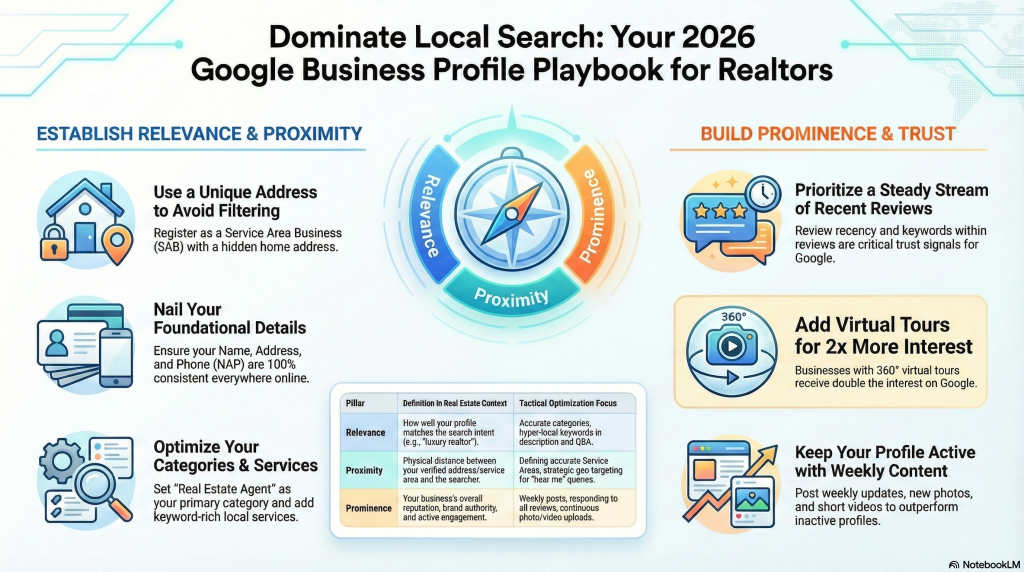
Truth #1: Your Prestigious Office Address Is Sabotaging Your Real Estate SEO
The Myth: Using your brokerage’s main office address builds credibility and authority.
The Reality: This is one of the most damaging mistakes individual agents make for real estate SEO.
When dozens—or even hundreds—of agents list the same brokerage address, Google’s spam filter (the “possum” filter) kicks in. The algorithm views this as suspicious clustering and responds by filtering most profiles from search results. You become algorithmically invisible, buried beneath the one or two agents at that address who claimed it first.
The Winning Strategy: Become a Service Area Business (SAB)
Unless you have a dedicated, permanent office with your own signage (not just a cubicle), the smarter approach is registering as a Service Area Business.
Verification: Use your unique home address for verification.
Privacy: Google automatically hides this address from public view.
Targeting: Define specific cities, ZIP codes, or neighborhoods you serve.
While hiding your address feels counterintuitive, this creates the unique digital identity Google needs to see you as an eligible competitor. You stop being one of 100 pins at a brokerage and start being a distinct business serving the Austin-San Antonio corridor.
Truth #2: Client Reviews Are Writing Your SEO (Not Just Building Trust)
The Myth: Reviews are simply social proof for potential clients.
The Reality: Reviews are data for Google’s algorithm, and are a direct, powerful Real Estate SEO tool
Google’s AI doesn’t just count stars; it reads. It scans the text within reviews for keywords that match searcher intent.
The “Best Realtor” Ranking Hack
Studies show that reviews containing exact-match phrases like “best realtor in New Braunfels” can cause a profile to skyrocket for that specific term. Furthermore, recency trumps quantity. A profile with 200 reviews can tank if no new reviews have come in for six months.
How to Ask for Reviews Strategically
Stop asking for “a review.” Ask for a story. Prompt your clients with questions that generate SEO gold:
“What neighborhoods did we look in?”
“How did I help you negotiate the price?”
“What was it like buying your first home in [City Name]?”
When a client writes, “Steve helped us find the perfect home in Comal County,” they are training Google’s AI to cite you as the authority for that area.
Truth #3: You’re Wasting Time on Geotagging Photos
The Myth: Adding GPS coordinates to photo EXIF data boosts local rankings.
The Reality: Google ignores artificially manipulated metadata.
Multiple studies confirm that using software to inject GPS coordinates into stock photos has no statistically significant effect on rankings when it comes to real estate SEO.
The Best Practice: Skip the paid geotagging tools. Instead, upload photos directly from your phone via the Google Maps app while you are at the location (open houses, closings, inspections). This naturally attaches valid metadata that Google trusts.
Truth #4: AI-Powered Search Is Replacing Traditional Results
The Paradigm Shift: Google has shifted toward “Ask Maps,” an AI-powered system that generates instant answers using Gemini AI. Users are asking questions like “Who is the best agent for first-time buyers in Hill Country?” and getting a direct answer—not a list of links.
If your content isn’t structured for AI, you are invisible.
Strategy: The FAQ Page & Schema Markup
You need a dedicated FAQ page on your website that answers specific market questions.
“What is the average time to sell a home in New Braunfels?”
“Which neighborhoods have the best schools in San Antonio?”
The Technical Edge: Ask your web developer to implement FAQ Page Schema Markup. This is code that tells Google, “This is a question, and here is the answer.” This makes it incredibly easy for Google’s AI to pull your answer and serve it to the user directly on the search page.
Truth #5: “Prominence” Is the Only Ranking Factor You Can Control
Google’s local algorithm relies on three pillars: Relevance, Proximity, and Prominence.
Relevance: Are you a realtor? (Yes).
Proximity: Are you near the searcher? (You can’t control this).
Prominence: How active and trusted are you? (You control this).
Consistency Beats Intensity
Many agents post daily for a month and then burn out. Google interprets the silence as a business that has closed. It is better to post one Google Update per week for a year than to post daily for a month and disappear.
Your Weekly “Prominence” Checklist:
Get 1 new detailed review.
Post 1 Google Update (listing, market insight, or client win).
Upload 2 new photos from your phone.
Reply to all reviews.
The Bottom Line: Partner with a Lender Who Invests in Your Growth
Mastering Google for success with real estate SEO is critical for building a modern real estate business, but you shouldn’t have to do it alone. The most successful agents build teams of strategic partners who provide business-building value—not just rate sheets.
At Edge Home Finance, I am committed to helping my agent partners win more business. My goal isn’t just to close loans; it’s to help you grow a thriving, lead-generating real estate practice in the Texas market.
Ready to partner with a lender who is as invested in your success as you are?
Contact Steve Tomaselli at Edge Home Finance Let’s build your business together.