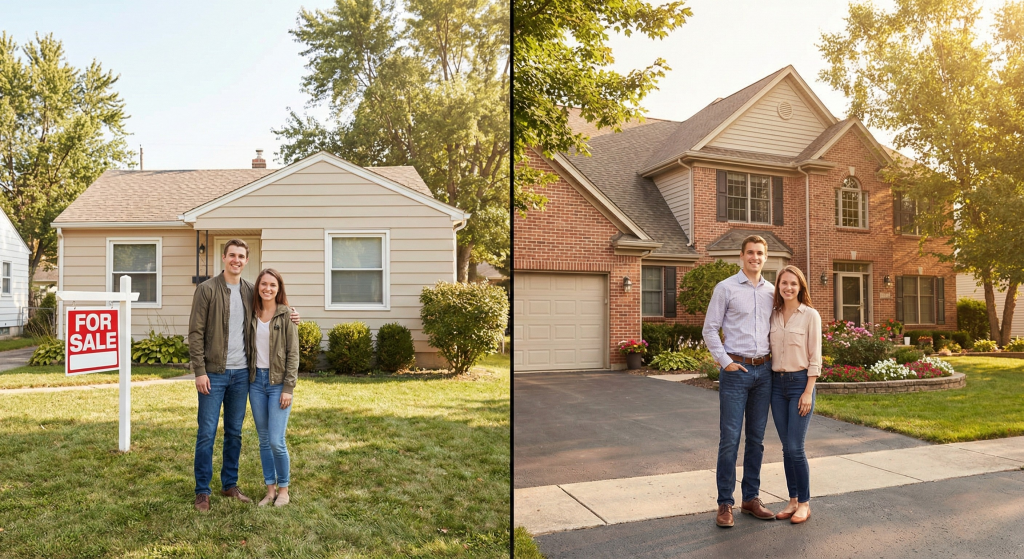
Can I buy a home while I still own my current home?
Quick Answer: Learning how to buy a house while selling your current home is easier than you think. Yes, you can buy a new home before selling your current one. The four main strategies are: selling first with a lease-back, buying first using bridge financing or equity, making a contingent offer, or using a buy-before-you-sell program. The best option depends on your financial situation and local market conditions.
I’ve personally bought two homes while still owning my previous properties, and as a mortgage loan originator, I’ve helped hundreds of clients do the same. Here’s what I’ve learned: it’s way less complicated than most people think when you know your options.
Can You Buy a House Before Selling Your Current One?
Yes, absolutely. Whether you can (or should) depends on three factors:
Your debt-to-income ratio – Can you qualify for a new mortgage while still owning your current home?
Your available equity – Do you have enough equity to access for a down payment?
Your cash reserves – Can you comfortably handle overlap expenses if needed?
Most lenders will calculate your debt-to-income ratio including both mortgage payments. If you’re under 43-45% DTI with both loans, you’re typically in good shape.
Strategy #1: How to Buy a House While Selling Your Current Home (The Low-Risk Approach)
This is the most financially conservative path and the one most first-time move-up buyers choose.
How It Works
You list and sell your current home first, which gives you:
- Known equity amount for your down payment
- Stronger purchasing power
- No risk of carrying two mortgages
- Cleaner qualification for your new loan
The Challenge: Where Do You Live Between Homes?
This is where most people get stuck. The solution? A lease-back agreement (also called rent-back or post-closing occupancy).
What is a lease-back agreement? You sell your home, close as scheduled, then rent it back from the new owner for 30-60 days while you find your next home.
I’ve seen this work countless times. Buyers often agree to it because it makes your property more attractive when you’re competing with other sellers.
Pro Tips for Selling First
Get pre-approved before listing so you know your exact buying power once you have sale proceeds in hand. Time your home prep and listing so you’re ready to shop immediately after closing. Consider temporary housing or staying with family if a lease-back isn’t possible.
Best for: Buyers who need their equity for the next down payment, anyone prioritizing financial safety, or those comfortable with temporary housing arrangements.
Strategy #2: Buy First, Then Sell (Maximum Control)
This is the path I took both times, and it’s game-changing if you can swing it financially.
Can You Qualify for Two Mortgages at Once?
Many buyers can, especially if:
- Your debt-to-income ratio is low (under 36% before the second mortgage)
- You have strong income documentation
- Your credit score is 700+
- You have 6+ months reserves
An average lender can run these numbers in about 10 minutes. My Affordability Navigator allows you to get your answer in about 30 seconds.
Three Ways to Buy Before You Sell
Bridge Loan
A bridge loan is short-term financing (usually 6-12 months) that unlocks equity from your current home to use as a down payment on your new one.
How it works: The lender gives you access to your equity (typically up to 80% of your home value minus your current mortgage). You use this for your down payment. When your old home sells, you pay off the bridge loan.
Interest rates: Expect 2-4% higher than a traditional mortgage, but you only pay interest for the months you use it.
Home Equity Line of Credit (HELOC)
If you have at least 20% equity in your current home, a HELOC lets you borrow against it.
How it works: You open a credit line secured by your current home. You draw what you need for your down payment. You make interest-only payments until your home sells, then pay off the HELOC.
Timeline: HELOCs take 2-4 weeks to close, so plan ahead.
Qualifying for Both Mortgages Simultaneously
If your income supports it, you can simply qualify for the new mortgage while keeping your current one. Lenders will count your existing mortgage payment as part of your debt obligations.
This is how I bought my last home. My debt-to-income ratio was low enough that I could carry both payments for about 45 days while I prepped and sold my previous house.
Real-World Example
Let’s say you have a $300,000 home with a $150,000 mortgage. You want to buy a $450,000 home.
Option A (Bridge Loan): You get a bridge loan for $90,000 (80% of home value minus current mortgage = $240,000 – $150,000). Use that for your down payment. When you sell, pay off both the original mortgage ($150,000) and bridge loan ($90,000).
Option B (HELOC): Open a $90,000 HELOC, draw $90,000 for down payment, make interest-only payments for two months, pay off HELOC when you sell.
Best for: Buyers who can qualify with both mortgages, anyone wanting to avoid rushed decisions, or those in competitive markets where contingent offers don’t work.
Strategy #3: Make a Contingent Offer
A contingent offer means you’re offering to buy the new home contingent upon selling your current one first.
How Do Contingent Offers Work?
You write an offer that includes a home sale contingency clause stating that if your home doesn’t sell within a specified timeframe (usually 30-60 days), you can back out without penalty.
When Do Contingent Offers Work?
They work well in:
- Buyer’s markets with higher inventory
- Slower-moving neighborhoods
- Rural or suburban areas
- Off-peak seasons (November-February)
They struggle in:
- Hot seller’s markets
- Urban areas with low inventory
- Multiple offer situations
- Luxury price points
How to Strengthen a Contingent Offer
Have your home already listed or under contract before making your offer. Provide proof of strong pre-approval. Offer a shorter contingency period (21 days instead of 60). Include an escalation clause and flexible closing terms. Consider a “kick-out clause” that gives the seller protection if they get a better offer.
What is a kick-out clause? This allows the seller to continue marketing their home. If they get a non-contingent offer, you have 72 hours to remove your contingency or lose the house.
I’ve seen contingent offers work beautifully for clients buying in established suburbs where homes take 30-45 days to sell anyway.
Best for: Buyers in balanced or slow markets, those who can move quickly once their home sells, or anyone unwilling or unable to carry two mortgages.
Strategy #4: Buy-Before-You-Sell Programs (The New Option)
These programs have exploded in popularity over the past few years because they eliminate timing stress completely.
How Do Buy-Before-You-Sell Programs Work?
Companies like HomeLight, Knock, and some lenders offer programs where they essentially front the money for your new home purchase.
The typical process:
- You qualify for the program based on your equity and creditworthiness
- The company buys your new home with cash (making you an ultra-competitive buyer)
- You move into your new home
- You list and sell your old home on your timeline (usually within 6 months)
- You finalize your mortgage on the new home, and proceeds from your old home sale pay back the program
What Do These Programs Cost?
Expect fees ranging from 1-3% of the purchase price, plus you’ll pay interest on the financing during the transition period. When you factor in the convenience and competitive advantage, many buyers find it worthwhile.
Are You a Cash Buyer with These Programs?
From the seller’s perspective, yes. Your offer shows up as cash with no financing contingency, which makes it incredibly attractive in competitive markets.
I’ve worked with clients using these programs in hot markets, and their offers get accepted over higher bids simply because they’re “cash.”
Best for: Buyers in competitive markets, anyone wanting a stress-free transition, or those who value convenience over saving every dollar.
How to Choose the Right Strategy: Decision Framework
Let me make this really simple based on what I’ve seen work in real situations.
Choose “Sell First” If:
- You need proceeds from your sale for your next down payment
- Your debt-to-income ratio is already high (above 40%)
- You have minimal savings beyond your down payment
- You’re risk-averse and want maximum financial safety
- You’re in a hot seller’s market where homes sell in days
Choose “Buy First” If:
- You can qualify for both mortgages simultaneously
- You have equity you can access via bridge loan or HELOC
- You want complete control over your timeline
- You’re in a competitive buyer’s market
- You have specific requirements and can’t afford to settle
Choose “Contingent Offer” If:
- You’re buying in a slower market or during off-season
- Your home is likely to sell quickly (desirable neighborhood, good condition)
- You’re emotionally prepared to potentially lose your dream home
- Sellers in your area commonly accept contingencies
Choose “Buy-Before-You-Sell Program” If:
- You’re competing in a hot market where cash offers dominate
- You can’t qualify for traditional bridge financing
- You value convenience and reduced stress
- The program fees fit your budget
Common Questions About Buying and Selling Simultaneously
How Long Does the Process Typically Take?
If you sell first: 30-60 days to sell your home, plus another 30-45 days to find and close on your new home. Total: 2-4 months.
If you buy first: Immediate purchase, then 30-90 days to sell your existing home depending on market conditions.
What If My Home Doesn’t Sell as Quickly as Expected?
This is why buying first requires either qualification for both mortgages or bridge financing with enough cushion. I always tell clients to budget for 3-6 months of overlap as a safety net, even if you expect 30-60 days.
Can You Use FHA or VA Loans When Buying Before Selling?
FHA loans are challenging because you can typically only have one FHA loan at a time unless you’re relocating more than 100 miles for work. VA loans are more flexible—you can have multiple VA loans as long as you have sufficient remaining entitlement.
What Happens If You Can’t Afford Both Mortgages?
If you overestimate your ability to carry both payments, you may need to rent out your old home temporarily, reduce the price aggressively, or consider a short-term personal loan to bridge the gap. This is why running real numbers with a lender beforehand is critical.
The Biggest Mistake Move-Up Buyers Make
Here’s what I see constantly: people start touring homes and fall in love with something before they understand their actual options and numbers.
Then they’re stuck trying to reverse-engineer a strategy, and they end up making expensive compromises or losing out on homes they really wanted.
The Right Sequence
Week 1: Talk to a mortgage lender and run all scenarios—sell first, buy first, bridge loans, contingent offers. Get pre-approved.
Week 2-3: If selling first, prep and list your home. If buying first, start shopping and make an offer when ready.
Week 4+: Execute your strategy based on market conditions and personal comfort level.
A 30-minute strategy call with a lender can save you literally thousands of dollars and months of stress. I’ve seen both sides of this equation, and planning ahead makes all the difference.
What to Discuss with Your Lender
When you talk to a mortgage professional about your move-up strategy, here’s what you should walk away knowing:
Your maximum loan amount if you carry both mortgages. Whether you qualify for bridge financing and the costs. Your debt-to-income ratio with and without your current mortgage. How much equity you can access from your current home. The monthly payment difference between all scenarios. Estimated closing costs and cash needed for each strategy.
Don’t guess. Don’t assume. Get actual numbers.
Final Thoughts: It’s Simpler Than You Think
I was nervous before buying my first home while still owning another one. I thought the timing would be impossible and the financial burden would be overwhelming.
But you know what? It worked smoothly both times because I ran the numbers first, understood my options, and picked the strategy that fit my situation.
You can absolutely do this. The key is making an informed decision based on your real financial picture, not on fear or assumptions. Now that you know how to buy a house while selling your current home, you can move forward with confidence.
Ready to Create Your Move-Up Strategy?
Let’s talk through your specific situation. I’ll run your actual numbers, explain every option available to you, and help you build a clear plan for buying your next home.
We’ll cover bridge loans, HELOCs, contingent offers, buy-before-you-sell programs, and traditional sell-first strategies. No pressure, no sales pitch—just real guidance from someone who’s been exactly where you are.
Schedule your move-up buyer strategy call and let’s map out the smartest path forward for you.
About the Author: I’m Steve Tomaselli, a mortgage loan originator who specializes in helping move-up buyers navigate the transition between homes. I’ve personally bought two homes while selling my previous properties, and I work with clients every day who are doing the same.
One Response