
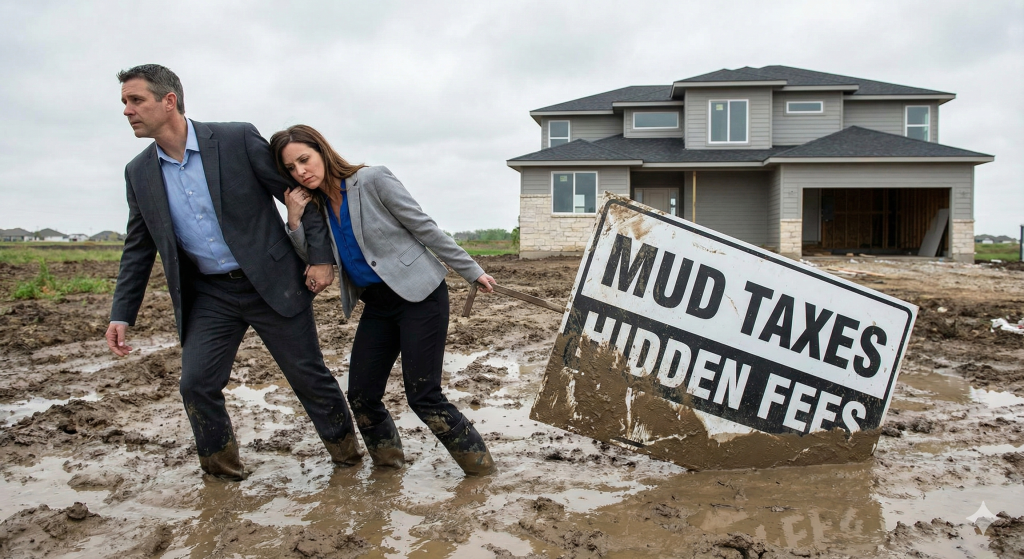
The "Shiny Object" Trap: Is Texas New Construction Costing You Thousands More Than Resale?
Quick Answer: While builders in Central Texas offer attractive teaser interest rates, the hidden costs of MUD taxes and inflated sales prices often make new construction a worse financial deal than resale. Recent market data shows resale buyers securing significantly more equity and lower monthly payments by negotiating lower prices rather than paying premiums for builder incentives.
If you are house hunting in Central Texas, you’ve likely noticed a trend: established resale homes in neighborhoods like New Braunfels, Kyle, Buda, or Georgetown often sit on the market, while new construction developments are buzzing with activity.
Builders are aggressively marketing “lower-than-market” interest rates and “move-in ready” incentives. But as a mortgage professional seeing the numbers behind the scenes, I have to be honest: New construction is often a significantly worse financial deal than buying a resale property.
While the mortgage rate might look low today, the hidden costs—specifically MUD taxes, WID taxes, and the “tax assessment trap”—can turn your dream home into a monthly financial nightmare.
1. The Alphabet Soup of Extra Taxes (MUDs, PIDs, and WIDs)
Most new subdivisions in the Texas Hill Country and the Austin-San Antonio corridor are built on raw land that didn’t originally have city water or roads. To pay for infrastructure, developers form special tax districts:
MUD (Municipal Utility District)
PID (Public Improvement District)
WCID (Water Control and Improvement District)
These are taxes added on top of your standard property tax bill. While a resale home in an established neighborhood might have a total tax rate of 1.8% to 2.2%, a new build in a MUD often has a tax rate of 2.8% to 3.5%.
The Math: On a $450,000 home, that 1% difference is an extra $375 per month out of your pocket, forever (or for a VERY long time).
HINT: Verify the specific tax rates for any property at the official Texas Property Tax Transparency website.
2. The “Unimproved Land” Qualification Trick
This is the most dangerous trap for Texas new construction buyers. When you apply with a builder’s preferred lender, they often estimate your monthly property taxes based on the current tax assessment—which classifies the property as “unimproved land” (a dirt lot).
The lender uses this artificially low number (maybe $50/month in taxes) to help you qualify. But 12 to 18 months later, the County Appraisal District catches up. They assess the property as a completed house, and your tax bill jumps from $600/year to $12,000/year.
We frequently see new build owners experience massive “payment shock,” seeing their mortgage jump by $600 to $900 per month overnight to cover the shortage.
3. Proof in the Numbers: A Real-World Case Study
You don’t have to take my word for it. We recently proved that the resale market is where the actual value is hiding, and it is NOT in Texas new construction!
While builders were holding firm on inflated prices to cover their rate buy-downs, we helped a VA buyer in New Braunfels ignore the shiny new builds and target a resale property.
The Breakdown: Instead of paying full price for a builder’s rate, this buyer negotiated hard on a resale home.
Sales Price: Secured $80,000 OFF the list price.
Instant Equity: The home appraised for $55,000 OVER what they paid.
Seller Concessions: The seller paid $12,000 in closing costs.
The Result: A 30-year fixed VA rate at 5.4% with $0 out of pocket.
The Lesson: This buyer avoided the MUD tax trap and walked into $55,000 of immediate wealth. Had they bought a new build, they likely would have paid a premium price just to get that same interest rate, starting with zero (or negative) equity.
The Bottom Line: Why Resale Wins
When you buy a resale home in an established community:
The Taxes are Known: The house has been fully assessed. The tax bill you see is the tax bill you get.
Lower Tax Rates: Older neighborhoods typically do not have MUD or PID taxes.
Better Value: You aren’t paying a premium for a “builder rate” subsidy.
Don’t let a shiny model home blind you to the math. Before you sign a contract, ask a local, independent mortgage professional to run a “fully assessed” tax scenario for you.
Frequently Asked Questions (FAQ)
Is it better to buy Texas new construction or resale in Texas right now? Financially, resale homes currently offer better value. Sellers of existing homes are more willing to negotiate significantly on price (often 10-15% below list), whereas builders often keep prices high to cover the cost of their promotional interest rates.
What is the “Tax Trap” with new construction homes? Lenders often qualify buyers on the taxes for the “unimproved land” (the dirt lot) before the house is assessed. Once the county assesses the completed house (usually 12 months later), the monthly mortgage payment can increase by hundreds of dollars to cover the new, higher tax bill.
Are MUD taxes permanent? MUD (Municipal Utility District) taxes stay in place until the bonds used to build the infrastructure are paid off, which can take 20 to 30 years. As the debt is paid down, the rate may decrease, but it is a long-term cost that resale homes in established city limits often do not have. MUD taxes are regulated by the Texas Commission on Environmental Quality (TCEQ), which oversees these districts.
The Bottom Line
Builders employ professional sales teams trained to sell you a monthly payment based on temporary math. My job is to protect you with actual math.
If you want to see the real numbers—including MUDs, PIDs, and future tax assessments—reach out today. Let’s make sure your “dream home” doesn’t become a financial nightmare.
The “Shiny Object” Trap: Why New Construction in Central Texas May Be Costing You Thousands More Than Resale
Quick Answer: While Texas new construction offers attractive teaser interest rates, the hidden costs of MUD taxes and inflated sales prices often make new construction a worse financial deal than resale. Recent market data shows resale buyers securing significantly more equity and lower monthly payments by negotiating lower prices rather than paying premiums for builder incentives.
If you are house hunting in Central Texas, you’ve likely noticed a trend: established resale homes in neighborhoods like New Braunfels, Kyle, Buda, or Georgetown often sit on the market, while new construction developments are buzzing with activity.
Builders are aggressively marketing “lower-than-market” interest rates and “move-in ready” incentives. But as a mortgage professional seeing the numbers behind the scenes, I have to be honest: New construction is often a significantly worse financial deal than buying a resale property.
While the mortgage rate might look low today, the hidden costs—specifically MUD taxes, WID taxes, and the “tax assessment trap”—can turn your dream home into a monthly financial nightmare.
1. The Alphabet Soup of Extra Taxes (MUDs, PIDs, and WIDs)
Most new subdivisions in the Texas Hill Country and the Austin-San Antonio corridor are built on raw land that didn’t originally have city water or roads. To pay for infrastructure, developers form special tax districts:
MUD (Municipal Utility District)
PID (Public Improvement District)
WCID (Water Control and Improvement District)
These are taxes added on top of your standard property tax bill. While a resale home in an established neighborhood might have a total tax rate of 1.8% to 2.2%, a new build in a MUD often has a tax rate of 2.8% to 3.5%.
The Math: On a $450,000 home, that 1% difference is an extra $375 per month out of your pocket, forever.
2. The “Unimproved Land” Qualification Trick
This is the most dangerous trap for new build buyers. When you apply with a builder’s preferred lender, they often estimate your monthly property taxes based on the current tax assessment—which classifies the property as “unimproved land” (a dirt lot).
The lender uses this artificially low number (maybe $50/month in taxes) to help you qualify. But 12 to 18 months later, the County Appraisal District catches up. They assess the property as a completed house, and your tax bill jumps from $600/year to $12,000/year.
We frequently see new build owners experience massive “payment shock,” seeing their mortgage jump by $600 to $900 per month overnight to cover the shortage.
3. Proof in the Numbers: A Real-World Case Study
You don’t have to take my word for it. We recently proved that the resale market is where the actual value is hiding.
While builders were holding firm on inflated prices to cover their rate buy-downs, we helped a VA buyer in New Braunfels ignore the shiny new builds and target a resale property.
The “Win of the Week” Breakdown: Instead of paying full price for a builder’s rate, this buyer negotiated hard on a resale home.
Sales Price: Secured $80,000 OFF the list price.
Instant Equity: The home appraised for $55,000 OVER what they paid.
Seller Concessions: The seller paid $12,000 in closing costs.
The Result: A 30-year fixed VA rate at 5.4% with $0 out of pocket.
The Lesson: This buyer avoided the MUD tax trap and walked into $55,000 of immediate wealth. Had they bought a new build, they likely would have paid a premium price just to get that same interest rate, starting with zero (or negative) equity.
The Bottom Line: Why Resale Wins
When you buy a resale home in an established community:
The Taxes are Known: The house has been fully assessed. The tax bill you see is the tax bill you get.
Lower Tax Rates: Older neighborhoods typically do not have MUD or PID taxes.
Better Value: You aren’t paying a premium for a “builder rate” subsidy.
Don’t let a shiny model home blind you to the math. Before you sign a contract, ask a local, independent mortgage professional to run a “fully assessed” tax scenario for you.
Frequently Asked Questions (FAQ)
Is it better to buy new construction or resale in Texas right now? Financially, resale homes currently offer better value. Sellers of existing homes are more willing to negotiate significantly on price (often 10-15% below list), whereas builders often keep prices high to cover the cost of their promotional interest rates.
What is the “Tax Trap” with new construction homes? Lenders often qualify buyers on the taxes for the “unimproved land” (the dirt lot) before the house is assessed. Once the county assesses the completed house (usually 12 months later), the monthly mortgage payment can increase by hundreds of dollars to cover the new, higher tax bill.
Are MUD taxes permanent? MUD (Municipal Utility District) taxes stay in place until the bonds used to build the infrastructure are paid off, which can take 20 to 30 years. As the debt is paid down, the rate may decrease, but it is a long-term cost that resale homes in established city limits often do not have.

4 Responses